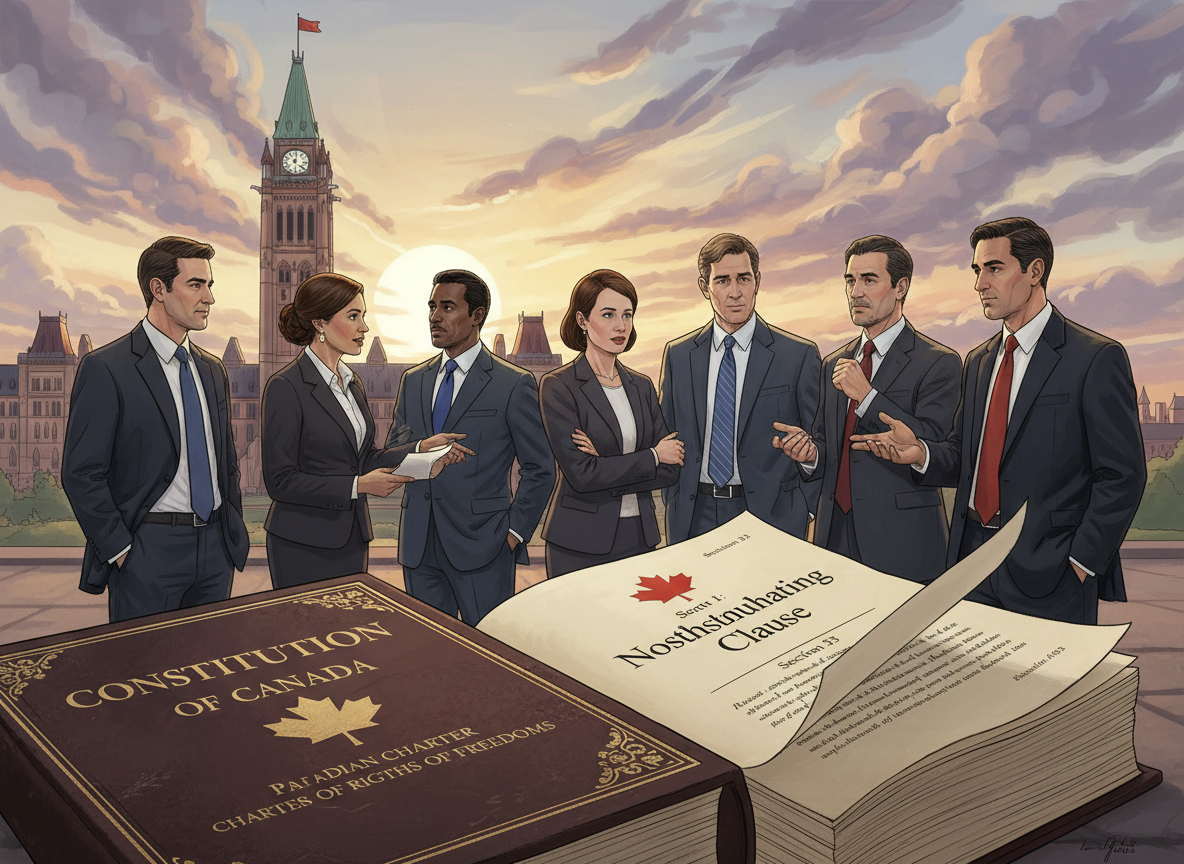
For over 20 times, the “notwithstanding clause” has been used or threatened in Canada. Yet, many Canadians don’t know its impact. This clause can pause fundamental freedoms for up to five years.
Section 33 of the Charter lets governments override key rights. This includes freedoms and equality rights. It means laws can bypass rights Canadians often take for granted.
The debate around this clause is ongoing. Some see it as a way to keep democratic power. Others fear it could lead to rights being taken away without enough public input.
The clause is seen as a compromise in Canadian law. Its use can be seen as necessary or dangerous, depending on the context.
This guide aims to explain the clause to Canadians. It covers its origins and recent uses. Every citizen should know how their rights can be affected by a single vote.
Key Takeaways
- The “notwithstanding clause” lets governments temporarily override Charter rights for up to five years.
- It only applies to certain rights, not all freedoms.
- This clause was a compromise for the 1982 Constitution.
- Provincial governments have used it more than the federal government.
- Canadian law requires a clear statement in the legislation for its use.
- Recent years have seen more debate about the clause as premiers consider using it.
Understanding the Notwithstanding Clause in Canadian Constitutional Law
Section 33 of the Charter is a powerful tool in Canadian governance. It lets elected legislatures pass laws that ignore certain rights. This is part of the Canadian Charter of Rights and Freedoms.
The “safety valve” in Canadian law is what experts call the override provision. It applies to certain Charter sections. Governments must say which rights they are overriding. This override can be renewed every five years.
Here’s what the override power can and cannot do:
| Charter Rights That Can Be Overridden | Charter Rights That Cannot Be Overridden |
|---|---|
| Fundamental freedoms (Section 2) — speech, religion, assembly | Democratic rights (Sections 3–5) — right to vote, elections |
| Legal rights (Sections 7–14) — life, liberty, fair trial | Mobility rights (Section 6) — right to move across provinces |
| Equality rights (Section 15) — protection from discrimination | Language rights (Sections 16–23) — English and French protections |
Here are some key rules for using Section 33:
- The legislature must explicitly declare it is using the clause
- The override applies for a maximum of five years per declaration
- Renewal requires a fresh legislative vote
- Courts retain the power to review whether the clause was properly invoked
The framers of the Constitution in 1982 created this clause. It balances judicial power with democratic accountability. It lets elected reps have a say in law, even if courts disagree. The sunset clause ensures rights are not permanently lost.
Historical Context and Parliamentary Supremacy in Canada
The concept of the notwithstanding clause Canada today was shaped by intense debates. In 1981, federal and provincial leaders disagreed on court power. They had to find a middle ground for the Constitution’s patriation.
Premier Peter Lougheed of Alberta was a key figure. He and other provincial leaders aimed to keep the Westminster tradition alive. This tradition emphasizes parliamentary power. At the same time, the Charter of Rights and Freedoms brought in American-style rights. Section 33 was the compromise between these two views.
Using the notwithstanding clause has been rare in Canada. But, its early uses set important precedents:
| Province | Year First Used | Purpose |
|---|---|---|
| Quebec | 1982 | Blanket application to all provincial legislation as a protest against patriation |
| Saskatchewan | 1986 | Back-to-work legislation during a labour dispute |
| Alberta | 2000 | Definition of marriage legislation |
Quebec’s use from 1982 to 1987 was the most notable. They applied the clause to every single piece of their laws. This was a strong statement against the Constitution without their agreement.
These early uses have shaped how Canadians see the notwithstanding clause. They highlight the ongoing debate between legislatures and courts. Knowing this history is key to understanding when governments can use the clause.
When Governments Can Use Charter Rights Suspension
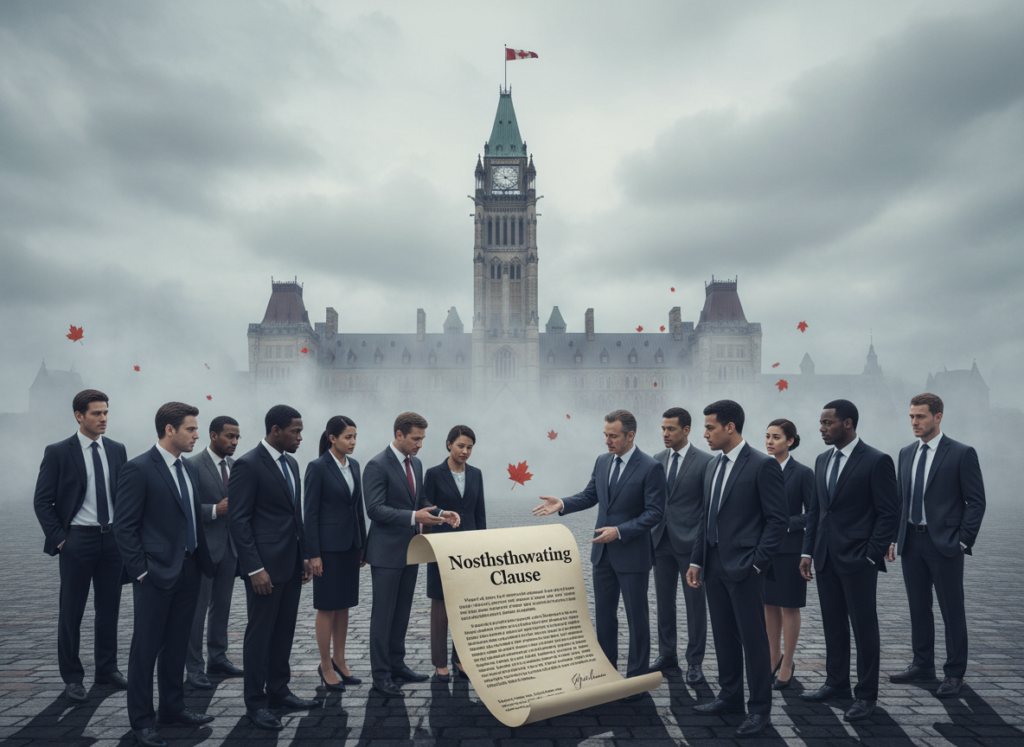
Charter rights suspension is not a vague or hidden power. It needs a clear, explicit declaration in a law. A government cannot imply it or apply it after the fact. It’s simple — a simple majority vote in the legislature is all it takes to pass it.
The five-year sunset clause in Section 33 of the Constitution Act, 1982 is a key safeguard. Every use of the clause expires after five years. A legislature must vote again to renew it. This cycle can repeat without limit, forcing elected officials to take a fresh stand each time.
Governments can use this legislative override power in two ways:
- Pre-emptively — before any court challenge arises
- Reactively — after a court strikes down a law as unconstitutional
The federal Parliament has never invoked the clause, though leaders like Jean Chrétien and Paul Martin discussed it during heated constitutional debates. Provincial governments, on the other hand, have used it multiple times.
| Province | Year | Purpose |
|---|---|---|
| Quebec | 1988 | French-language sign law (Bill 178) |
| Saskatchewan | 1986 | Back-to-work legislation during labour dispute |
| Ontario | 2018 | Reducing Toronto city council size (Bill 31) |
| Quebec | 2019 | Religious symbols ban in public sector (Bill 21) |
Each case sparked intense public debate. The five-year sunset clause ensures no single government can lock in a Charter rights suspension permanently. The legislative override power remains one of the most potent — and controversial — tools in Canadian democracy.
Recent Developments and Controversies Surrounding Charter of Rights Exemption

The debates over the Charter of Rights exemption in Canada have grown stronger. Many provinces are using this powerful tool, leading to new questions about rights and democracy.
In 2018, Ontario’s Premier Doug Ford used the exemption to change Toronto City Council. He used it again in 2022 to impose contracts on education workers. Both moves were met with strong public criticism, and the government withdrew its actions each time.
Quebec has been the most active in using this clause. In 2019, Bill 21 banned religious symbols for certain public workers. In 2022, Bill 96 strengthened French language rules. Critics say these laws hurt religious and linguistic minorities.
In 2023, Saskatchewan used the clause for school pronoun policies. This move sparked a debate about the rights of transgender youth.
| Province | Year | Legislation | Status |
|---|---|---|---|
| Ontario | 2018 | Toronto City Council restructuring | Withdrawn |
| Ontario | 2022 | Education worker contracts | Withdrawn |
| Quebec | 2019 | Bill 21 — Religious symbols ban | Active |
| Quebec | 2022 | Bill 96 — French language law | Active |
| Saskatchewan | 2023 | School pronoun policies | Active |
Constitutional scholars have different views. Some see the increasing use of the exemption as a threat to freedoms. Others believe it shows democratic will. This debate centers on the balance between legislative power and judicial oversight, a key issue for over four decades.
Conclusion
The notwithstanding clause is a unique tool in Canadian law. It balances protecting rights with the will of elected officials. This balance is key to Canada’s democratic system.
The five-year sunset clause helps keep this power in check. It forces governments to renew any rights suspension regularly. This gives voters a chance to decide before the clause is used again.
In recent years, provincial leaders have used this tool more often. What was once rare is now common in political debates. This change raises questions about minority rights and government limits.
For Canadians, understanding the notwithstanding clause is critical. As leaders test its limits, informed citizens can hold them accountable. The debate on when and how to use this power is ongoing.